

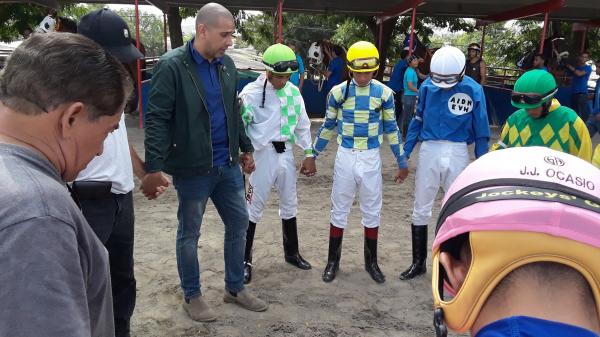
Earlier than the grandstand fills and lengthy earlier than the day’s first race, there’s a quieter rhythm on the bottom. Horses transfer by way of the morning. Staff are inclined to the routines that maintain a racetrack alive. And, typically throughout a break in coaching, a voice comes over the observe with a prayer — providing reflection, asking for security, and sharing a measure of sunshine for the day forward.
That voice belongs to some of the distinctive and quietly important members of the racing neighborhood: the racetrack chaplain. Chaplains serve a inhabitants as various as the game itself, transferring between barns, workplaces, bottom kitchens, chapel rooms, hospitals, fundraisers, and early-morning shedrows. Their work may be religious, sensible, pastoral, logistical, and, at occasions, life-saving.
On any given day, chaplains might pray with the gate crew and outriders, go to employees within the barns, manage meals banks and clothes closets, lead worship providers, prepare leisure actions, counsel households, reply to crises, or join folks with healthcare, authorized, immigration, housing, or monetary assets. Additionally they function a bridge between the bottom and the entrance aspect, showing at prayer breakfasts, night banquets, and fundraisers to remind racing administration of the individuals who maintain it.
The necessity is important. The horse racing workforce is extremely nomadic, with many employees transferring from observe to trace. Some arrive with little greater than what they’ll carry, generally coming from a distinct a part of the nation with out correct clothes or fundamental provides. The chaplaincy gives one thing regular: a well-known door, a listening ear, and a neighborhood prepared to assist.
The Race Monitor Chaplaincy of America traces its beginnings to founder Horace William “Salty” Roberts, who started ministering to racetrack employees and helped set up worship providers on the bottom. The group was included in 1972 and has grown into an interdenominational nonprofit community serving folks concerned in horse racing by way of native chaplaincies, councils, volunteers, and a nationwide workplace in Lexington, Ky.
Immediately, the nation RTCA helps affiliate chaplaincies and councils — the “boots on the bottom” — that serve racetracks, farms, and coaching facilities throughout the US, Canada, and Puerto Rico. Native packages differ by area. Some have a number of employees members; others depend on councils and volunteers. Collectively, they provide chapel providers, youth enrichment, girls’s packages, teen mentoring, recreation, emergency help, referrals, and day-to-day assist for employees and their households.
In Kentucky, the Race Monitor Chaplaincy program serves tracks together with Churchill Downs, Ellis Park, Turfway Park, Kentucky Downs, Belterra Park, and space coaching facilities. In New York, the chaplaincy helps a big bottom neighborhood with packages for employees and households. In Maryland, chaplaincy efforts have included English classes and reward baggage for grooms on Maryland Million Day. In California, a cornhole event at Santa Anita Park grew to become one other technique to construct fellowship and lift assist.
For Dan Waits, govt director of the RTCA, the center of that work begins with Salty Roberts’ story. Waits speaks of him with deep respect, recalling a person whose life modified dramatically after a troublesome interval marked by ingesting, unreliability, and disappointment. Roberts, as soon as an train rider, had reached a low level. The one job he may discover was as a car parking zone attendant on the observe. At some point, after arriving inebriated and mendacity down in his automobile, he was woke up by a university pupil who handed him a gospel tract. The second grew to become a turning level.
Roberts ultimately went to Calder Race Course with a brand new goal. “They took an outdated paint shack, introduced in an upright piano and had a church service for possibly eight folks,” Waits stated. “It was successful. Salty had a imaginative and prescient and made it his life’s mission to go round and plant chaplaincies all all through the horse racing business.”
Dogwood Steady founder Cot Campbell as soon as wrote that Roberts “embraced Christianity with the identical verve he had utilized to elevating hell in his formative years.” The outline match a person remembered for the depth of his religion, his weathered authenticity, and his readiness to wish on the slightest invitation.
From that starting, the nationwide group has turn out to be a assist system for the chaplains themselves. Waits manages the RTCA nationwide service heart in Lexington with Omar Aracena, director of development and operations; and Sandy Martin, administrative assistant. Their work consists of day-to-day operations, occasions, chaplain recruitment and schooling, ministry assets, funding steerage, chaplain faculty, the nationwide convention, and relationship-building with observe administration, horsemen’s teams, and the broader business.
The RTCA Board of Administrators, many with private ties to the equine world, consists of representatives with a shared dedication to serving horse racing employees. A community of regional and at-large ambassadors additionally connects the nationwide mission to native wants. By that construction, the chaplaincy can reply to considerations that vary from the best requirements like meals, clothes, or transportation to extra advanced challenges involving healthcare, immigration, funds, and household life.
RTCA additionally depends upon fundraising and business assist. Every year, the group hosts occasions together with a spring golf event and, throughout Breeders’ Cup week (this 12 months at Keeneland), “A Evening of Religion, Hope and Love.” The night options music, a visitor speaker, the RTCA Neighborhood Service Award, and the premiere of the RTCA White Horse Award video.
RTCA Founder’s Award recipient and Corridor of Fame jockey Pat Day, a previous president and longtime business spokesperson, understands why the calling is demanding. “I had many fantastic experiences throughout my 32 years as a Thoroughbred jockey,” Day stated, “however my work with the chaplaincy is decidedly extra rewarding and fulfilling.”
For Day, the energy of the ministry is discovered within the chaplains. “You’ve obtained to be referred to as to this ministry,” he stated. “It’s not a glamour job. They’re on the market early within the morning. Their congregation is the bottom employees, and it’s a really fluid inhabitants transferring from observe to trace.”
Chaplains, Day added, are anticipated to domesticate relationships throughout the racetrack, serve folks in onerous occasions, present religious care, and join with the entrance aspect of the observe so the broader racing neighborhood understands and helps the work.
Corridor of Fame jockey Mike Smith sees the identical dedication. “They’re an incredible group of individuals,” he stated. “They achieve this a lot for the bottom neighborhood and the entrance aspect, from all of the charity work they do to only being there to wish with the racetrack neighborhood.”
The tales that attain Waits are sometimes deeply private. “We’ve had folks getting ready to doing one thing horrible and drastic,” he stated. “They attain out to their chaplain. The chaplain gives the proper useful resource, or they supply the proper encouragement, or they only pay attention and pray with them. These tales occur on a regular basis.”
That’s the reason Waits says his personal function is to look after the caregivers. “My focus is to be a pastor to the chaplains and ensure they’re doing OK,” he stated. “How are you doing spiritually, mentally, and bodily? If I can make it possible for the oldsters within the area are doing properly and that they’re entire, they’re those which are the true heroes. My job is to make it possible for the heroes are geared up and that they’ve obtained what they want.”
In a sport constructed on pace, energy, and spectacle, racetrack chaplains are inclined to the quieter realities that make the business human. They minister to religious, emotional, bodily, social, and academic wants. They present up earlier than daybreak, keep current by way of disaster, rejoice milestones, mourn losses, and assist folks discover their footing. Their work might start with a prayer over the bottom, nevertheless it continues in numerous unseen acts of service — one dialog, one meal, one journey, one go to, one answered name at a time. In these moments, they make a distinction that reaches far past the racetrack.
