

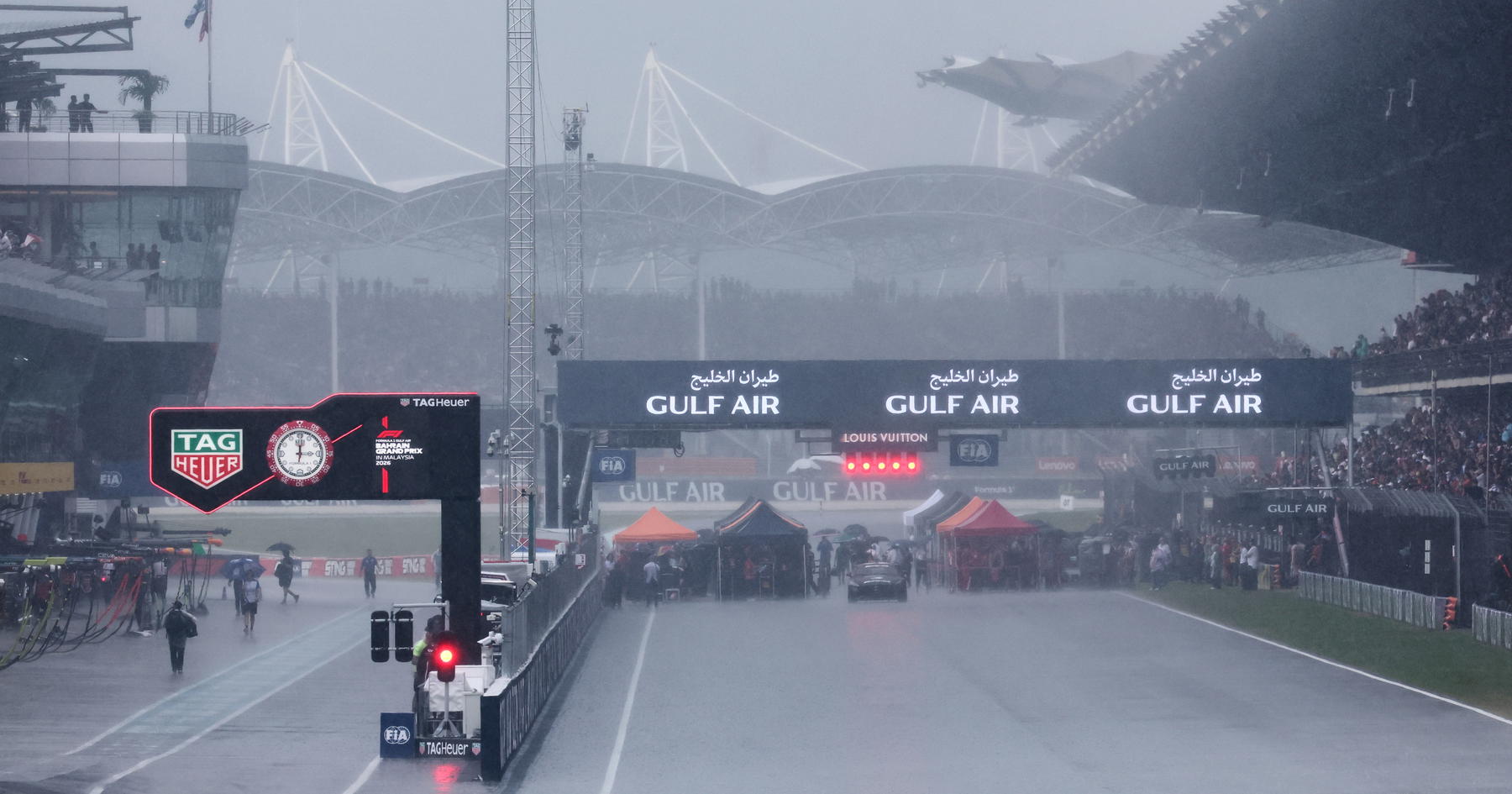
The Bahrain Grand Prix in Malaysia on the Sepang Worldwide Circuit was as a consequence of get underway at 15:00 native time, however heavy rain and lightning have pressured the begin to be delayed.
The FIA has confirmed that rain depth has remained regular, whereas the medical automobile has been despatched onto the circuit to additional assess situations.
The specter of a shortened race is especially vital given Sepang’s historical past with excessive climate.
The circuit’s scheduled race distance is 56 laps, which means the present F1 laws present 4 distinct factors thresholds which can be significantly simple to calculate.
How does the F1 shortened-race factors system work?
Beneath the F1 laws, factors are awarded in accordance with the gap accomplished by the race chief when the grand prix ends — or is said.
There is a vital change from the previous system: F1 not merely awards half factors for a race that falls in need of 75 per cent distance. As a substitute, there are 4 ranges of factors.
For any factors to be awarded, the race chief should first full not less than two full and consecutive laps with out a Security Automobile or Digital Security Automobile process. After that, the factors rely on how far the chief has travelled.
With the Bahrain Grand Prix in Malaysia scheduled for 56 laps, the thresholds are significantly easy.
These are the factors obtainable to each the drivers’ and constructors’ championships.
So, for instance, if the race is stopped after 20 laps, the winner would obtain 13 factors somewhat than the total 25.
If 30 laps are accomplished, the winner receives 19 factors.
As soon as the chief has accomplished 42 laps, or 75 per cent of the scheduled distance, the total allocation is accessible.
What occurs if the race doesn’t attain two laps?
No factors are awarded except the chief completes not less than two full consecutive laps with out a Security Automobile or VSC interval.
Which means the FIA can not merely award factors as a result of the automobiles have taken to the observe and accomplished just a few laps behind the Security Automobile. The required situations within the laws must be met.
Why is the 56-lap distance essential?
The Sepang race distance makes the 4 thresholds simple to recollect.
- 13 laps = under 25 per cent
- 14 laps = 25 per cent
- 28 laps = 50 per cent
- 42 laps = 75 per cent
- 56 laps = full race distance
Which means each further quarter of the race accomplished can have a major influence on the championship factors obtainable.
As an illustration, if the rain forces the race to finish after 27 laps, the winner scores 13 factors. If the sector manages only one extra lap, the race crosses the 50 per cent threshold, and the winner’s haul jumps to 19 factors.
The distinction between ending at 27 and 28 laps may due to this fact be six factors for the winner.
Sepang has kind in terms of rain
The opportunity of a closely disrupted race ought to come as little shock at Sepang.
Malaysia’s tropical local weather means thunderstorms and sudden heavy downpours are an everyday characteristic, with the official Malaysian climate service forecasting thunderstorms round Sepang on Sunday and temperatures reaching 33°C.
The circuit can be famend for producing quickly altering situations. Drivers confronted dry and very scorching situations throughout Friday and Saturday of this yr’s occasion, however the specter of thunderstorms elevated as race day approached.
The mixture of intense warmth, excessive humidity and tropical storms has traditionally made predicting the climate at Sepang significantly troublesome.
Mercedes’ Kimi Antonelli even highlighted the circuit’s uncommon asphalt as a possible benefit in moist situations. The extremely abrasive, open-surfaced observe can permit water to empty between the stones somewhat than sitting on prime of the asphalt, doubtlessly lowering the chance of aquaplaning in odd rain.
However a tropical downpour can overwhelm even Sepang’s drainage.
What occurred on the 2009 Malaysian Grand Prix?
System 1 has already skilled certainly one of its most well-known weather-affected races at Sepang.
The 2009 Malaysian Grand Prix started in dry situations, however rain arrived across the quarter-distance mark earlier than creating right into a torrential storm.
Drivers struggled because the rain intensified, with standing water ultimately making the circuit successfully undriveable. The race was red-flagged after 31 of the scheduled 56 laps, with situations failing to enhance sufficiently for racing to renew.
Jenson Button was declared the winner for Brawn, forward of Nick Heidfeld and Timo Glock.
As a result of solely 31 of the 56 laps had been accomplished, the race had not reached the 75 per cent threshold required on the time for full factors. The highest eight due to this fact acquired half of the conventional factors allocation, as per the laws on the time.
Button acquired 5 factors for the victory, somewhat than 10, whereas Heidfeld scored 4 and Glock three.
The race grew to become one of many defining examples of how shortly situations can deteriorate at Sepang.
