

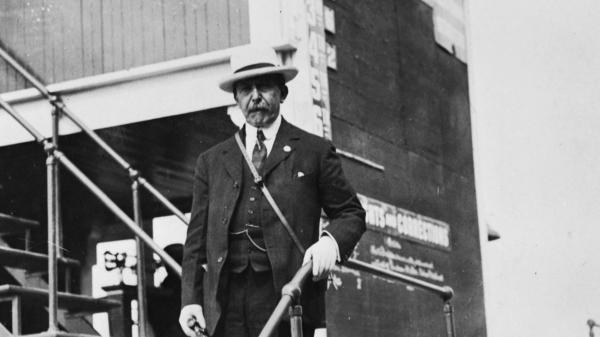
What number of males within the historical past of horse racing can declare to have bred the best colt and the best filly of their time?
Earlier than you reply “nobody” within the assumption that such a feat simply isn’t potential, enable us to introduce you to August Belmont II, whose contributions to the game have been so huge that he was one of many inaugural “Pillars of the Turf” inductees into the Nationwide Museum of Racing’s Corridor of Fame.
It’s not an exaggeration to say that Belmont was destined from start to exert a profound affect on racing. His father, August Belmont I, was a politician and businessman who bought concerned in racing by way of his pal Leonard Jerome, who inspired Belmont to tackle the function as president of a brand new racetrack known as Jerome Park. Regardless of having no background within the sport, Belmont accepted, and Jerome Park got here to fruition with the “Belmont Stakes” as one in every of its function races.
The elder Belmont subsequently established a pair of breeding farms in New York and Kentucky and was quickly having fun with success on the highest ranges of the game, even profitable his namesake race with Fenian in 1869. Upon Belmont I’s passing in 1890, Belmont II—already following in his father’s footsteps at August Belmont & Co., the household’s banking home—took up the mantel of carrying on the household’s racing legacy.
Suffice to say, Belmont II elevated that legacy to a wholly totally different degree.
For Belmont, racing was extra of a interest than a enterprise; his work took priority when crucial, which price him the chance to marketing campaign among the finest horses that he bred. However adopting such a viewpoint did enable Belmont to pursue racing in essentially the most sporting of manners, and Belmont’s objective was all the time to breed horses with considerable stamina that would excel at traditional distances. This he achieved with nice success, and judging from the general breadth and scale of his racing accomplishments, you’ll by no means guess that the game was something lower than Belmont’s lifelong focus.
Belmont’s preliminary foray into racing got here in 1891 when he bought seven mares from the dispersal of his father’s breeding inventory, together with one named Bella Donna that will have an enduring affect on Belmont’s breeding program. Belmont additionally selected to heart his operations at his father’s Nursery Stud in Kentucky and shortly turned actively concerned in managing the game at its highest ranges. He was among the many founding members of The Jockey Membership, the Nationwide Steeplechase Affiliation, and the Westchester Racing Affiliation, and likewise served because the chairman of the New York Racing Fee. As a part of the Westchester Racing Affiliation, Belmont—like his father—helped create a brand new racetrack in New York, and that monitor—opened in 1905—was named Belmont Park in honor of the Belmont household.
All of the whereas, Belmont’s breeding operation at Nursery Stud was producing a gradual string of stakes winners. Margrave and Merry Prince, born in 1893, have been among the many first, and Belmont would breed at the very least one stakes winner a yr for the remainder of his life. Actually, simply 10 years after he entered the game, Belmont organized for Bella Donna to be bred to the stallion Octagon, a stakes winner bred by Belmont a couple of years earlier. The ensuing foal, born in 1901, was a chestnut filly named Beldame, and he or she would quickly stake her declare as maybe the best racemare seen within the sport to that time limit.
Sadly, Belmont was not Beldame’s proprietor of file throughout her most notable season. As instructed by writer Edward Bowen in “Legacies of the Turf: A Century of Nice Thoroughbred Breeders (Vol. 1),” “Belmont was preoccupied with varied different endeavors, together with the financing of Decide Alton Parker’s unsuccessful run for president towards Teddy Roosevelt…”
In consequence, Belmont leased Beldame to his pal Newton Bennington for the yr 1904, and Beldame proceeded to rattle off 12 wins from 14 begins, crushing fellow fillies in such historic races because the Gazelle Stakes and Alabama Stakes and beating males with authority within the Saratoga Cup and Carter Handicap, amongst different races. She is taken into account to have been the Horse of the Yr for 1904, however after returning to Belmont for the 1905 season, she appeared to lack among the spark that had made her nice the yr earlier than, although she did handle to win the celebrated Suburban Handicap towards males.
Throughout the subsequent decade, Belmont’s racing and breeding program actually picked up as Rock View turned the champion 3-year-old of 1913, Friar Rock earned Horse of the Yr honors in 1916, and Hourless was deemed the co-champion 3-year-old of 1917. Moreover, Belmont loved a really memorable triumph when his colt Tracery received the historic 1 ¾-mile St. Leger Stakes in England. However as with Beldame, life outdoors of racing intervened simply earlier than the arrival of Belmont’s best champion. “[Belmont] had staked a lot of his private fortune within the Cape Cod Canal challenge,” wrote Bowen, referring to one in every of Belmont’s most extended and bold enterprise pursuits, “and the appearance of World Warfare I led him to serve his nation, regardless of his age, 65.”
In consequence, Belmont offered the vast majority of his 1917 foal crop, which sadly included the immortal Man o’ Warfare. When it comes to pedigree, Man o’ Warfare was a proud product of Belmont’s breeding program; Belmont had bred Man o’ Warfare’s sire, the gifted Belmont Stakes runner-up Truthful Play, and Belmont had imported Man o’ Warfare’s broodmare sire, the English Triple Crown winner Rock Sand. Seeing Man o’ Warfare race in Belmont’s silks would have been a becoming tribute to every thing Belmont had labored for in Thoroughbred racing, however because of the sale, the horse that some nonetheless think about to have been the best of all time carried the silks of Samuel D. Riddle to victory 20 occasions from 21 begins, shattering monitor information and dominating the game like few earlier than or since.
Lacking out on racing Man o’ Warfare will need to have been a disappointment for Belmont, and one solely exacerbated when one other horse Belmont had bred and offered—Mad Hatter—went on to win two editions apiece of the Metropolitan Handicap and Jockey Membership Gold Cup, within the course of incomes regard because the co-champion handicap male of 1921.
However Belmont was not discouraged, and within the final years of his life he bred a number of extra gifted stakes winners, together with the total brothers Likelihood Play (Horse of the Yr in 1927) and Likelihood Shot (winner of the 1927 Belmont Stakes). Each have been sons of Truthful Play.
Belmont handed away in December 1924 on the age of 71, forsaking a legacy of accomplishments that few within the sport can match. Breeding Man o’ Warfare and Beldame alone ensures that his title will reside on in racing ceaselessly.
Enjoyable Info
- For the reason that Belmont Stakes is known as after his household, it’s solely becoming that August Belmont II received the race on three events, with Masterman (1902), Friar Rock (1916), and Hourless (1917).
- Belmont is credited with having bred 129 stakes winners, together with 25 sired by Truthful Play, who was North America’s main sire by progeny earnings in 1920, 1924, and 1927. One other 13 have been sired by Rock Sand.
- Exterior of racing, one in every of Belmont’s foremost enterprise achievements was the creation of the Interborough Speedy Transit Firm, which constructed and operated the primary subways in New York Metropolis.
- Befitting of a person who helped discovered the Nationwide Steeplechase Affiliation, the final stakes winner that Belmont bred was the steeplechaser Fairfield.
