

Each season, there’s a specific type of novel that elicits its personal style of disdain. It’s one way or the other “too private” and likewise missing in “depth.” It’s known as issues like indulgent, trashy, lazy, artless, frivolous, embarrassing, or maybe simply very on-line. That is the mauvais style of our occasions, the gimmick of the not-quite-memoir, autofiction. Over the summer time, as Rachel Cusk’s Lifetime of M: A Novel took its flip, Grace Byron remarked that by now, hypothesis over the style’s boundaries of reality and fiction is “its personal bloodsport.” Since its rise within the 2010s, “the one factor trendier and triter than writing autofiction is hating autofiction,” as Sanjena Sathian put it in 2022. However why, if it is so foolish and unserious, does this style appear to pose such a permanent menace?
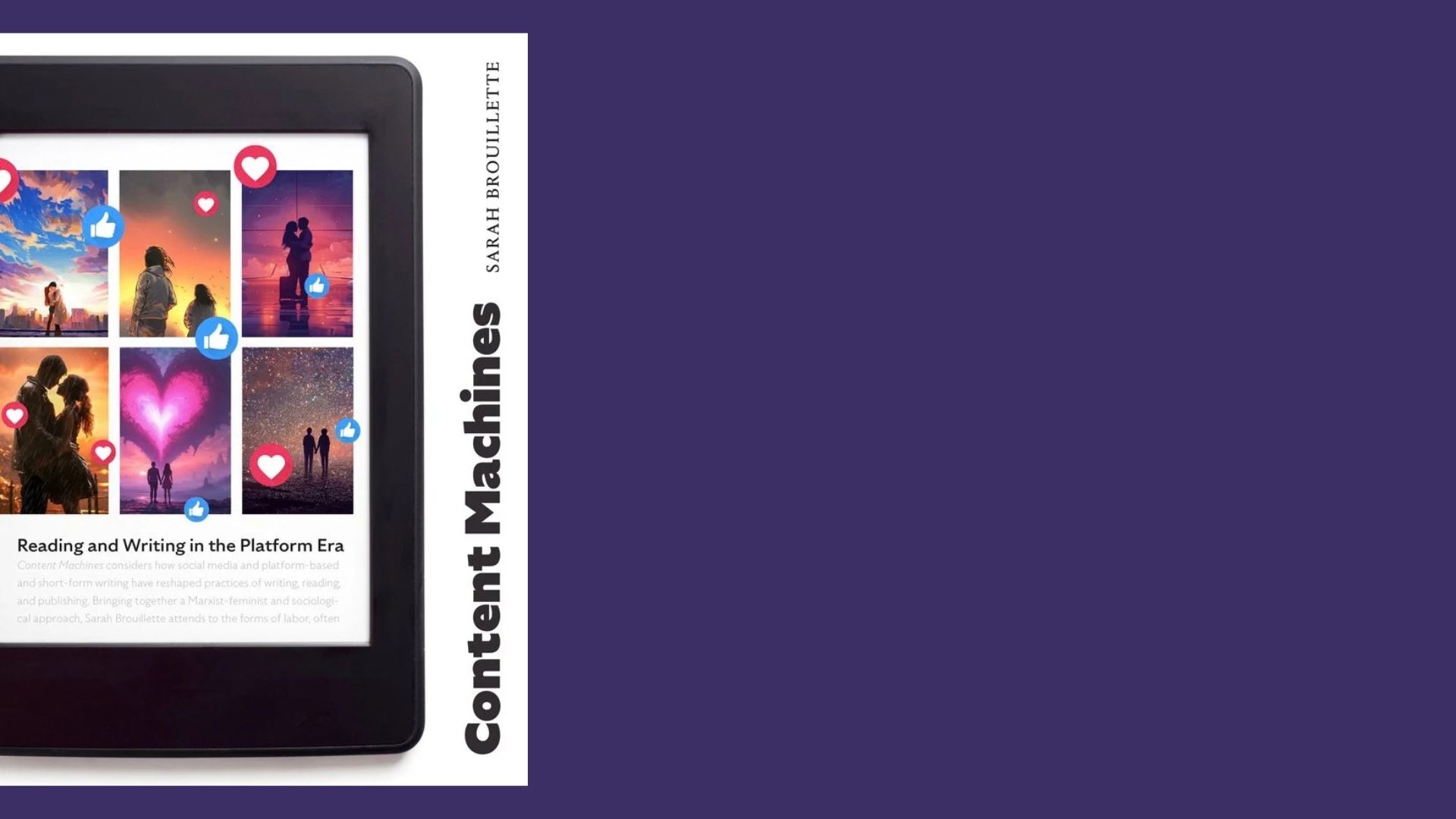
To perennial debates over autofiction and far else, Sarah Brouillette’s newest ebook Content material Machines is a welcome redirection from questions of literary advantage to a pointy historic evaluation of the up to date publishing trade—and plenty of of its attendant anxieties. Brouillette, a literary scholar and Marxist-feminist whose cultural criticism has appeared in Defector, continues the interventionary work of her earlier books on UNESCO, the artistic economic system, and the worldwide literary market, concerning up to date questions in regards to the “destiny of the literary”: “We’re instructed to fret in regards to the threats to literary artwork’s important ethical seriousness, distinction, problem, and function,” as she writes in Content material Machines. “We’re warned that publishing at the moment is overrun with what are mainly entitled shoppers: ideologically rigid, uncomfortable with onerous concepts and disagreement, untrained, incapable of nuanced thought, and all the time on the sting of tears or outage.” Somewhat than stoking the panic, Content material Machines traditionally situates it, uncovering pressing political questions on an period of publishing permeated by digital platforms corresponding to Wattpad, Kindle, and Audible, and social media phenomena like BookTok and Bookstagram.
Content material Machines examines digital platforms as “applied sciences of precarity,” instrumental to the ever-worsening labor situations in publishing. Extra particularly, Brouillette conceives of platforms as forces of feminization. It’s not simply that girls are doing extra of the roles and that the roles are getting worse. Ladies are doing extra of those jobs exactly as a result of they’re worse. “The extra work in writing and publishing turns into obtainable solely to these prepared to do it on a contingent foundation,” as Brouillette explains, “the extra it’s prone to be girls doing it,” as employees accustomed “to low-prestige work and to taking jobs that enable them to proceed with housekeeping and childcare.” That is the case throughout many workforces, and what we’re all the time actually speaking about each time masculinity is in “disaster.”
After all, there are different variations of this story about feminization, just like the one about how girls now supposedly dominate the trade, not solely pushing out males however the masculinist status that after constituted the literary. An trade that after produced the likes of David Foster Wallace and Jonathan Franzen now produces an countless stream of style fiction and self-help. Or here is one other model: Male novelists “vanished” from up to date literature as a result of girls learn greater than males. In his self-published essay “From Misogyny to No Man’s Land,” which had a viral second in 2024, Ross Barkan insists these are all indicators of the shrinking “interiority of males.” Dismissing the “gripes of educated girls on the state of the American male,” Barkan makes a case for males to return to writing their novels, a timeless masculinist endeavor: “Novels provide ambition on a spread not believable within the land of screens as a result of there is no such thing as a finances required, no gimmick or technological mastery—it’s uncooked creativeness, the best achievement of humankind.” Barkan, who extra lately discovered himself on the heart of a plagiarism scandal at New York journal, begs the query. What’s stopping all these males from writing their novels and attaining greatness? Maybe they’re ready for permission.
Solid as premonitions of “postliteracy,” the growth of particular (sure, girl-coded) genres like autofiction and private essays, Younger Grownup fiction, romance and romantasy displays an aesthetic shift deeply entangled within the feminization of publishing and digital platforms. Right here, as Brouillette reminds us, the affiliation between “gendered nonwork, presumed to be easy and ‘pure,’ and nonelite sentimental narrative genres corresponding to romance fiction” is troublesome to overstate. Above all, the romance and YA niches of publishing are the place probably the most unpaid and badly paid jobs could be discovered, and the place there’s probably the most uneven illustration of girls employees. Writers in these genres do most of their very own advertising, typically unpaid and with out the prospect of any advance, and totally on digital platforms. This entails the continued exercise of constructing and sustaining a web based authorial/writerly persona by social media posts on a number of platforms, podcast and webcast appearances, making content material for blogs and Substack and Patreon, and so forth. As in feminized relations of care, writers of the platform period are conditioned to think about their labor as a matter of affection and aspiration—making it not simply (or in all probability by no means) a method of getting paid. However even for those who can see by this romanticized work ethic, it doesn’t make platform work any much less exhausting for writers whose artistic output and livelihood are certain up in it, and presumably a number of different jobs.
Like Anna Kornbluh’s extremely influential 2024 ebook Immediacy, Content material Machines seeks to historicize up to date autofiction and its modes of self-narration. For Kornbluh, autofiction is the final word literary aesthetic of immediacy, indicative of “a brand new hegemony” of first-person narration. She describes autofiction as antifiction, a method “not made however simply extant,” jettisoning literary mediation and placing fictionality itself “beneath erasure.” As Kornbluh places it: “Somewhat than constructing character, [autofictions] advance a protagonist who is similar because the creator in title and circumstance and actual mates and actual household and, above all, actual voice. Somewhat than narrativity and plot, they purvey first-person present-tense uneventful short-spans, simply elliptical ruminations in actual time.” The place Kornbluh derides an “period of narcissism,” Brouillette locates the constraints of the author as feminized digital tradition employee, studying autofiction—together with confessionalism and trauma narratives—as among the dominant “gendered compulsions” of platform labor. Amongst these compulsions is a political downside on the heart of Content material Machines. It’s the concept, which platform labor and autofiction maintain in frequent, that “everybody has a narrative to inform,” the sheer function of which is to extract and flow into content material to draw extra customers.
Most of the highlights of Content material Machines come when Brouillette engages with texts that aren’t taken critically as “literature” (and maybe refuse to be), the place she brings the politics of latest longings for the literary into stark reduction. These texts vary from self-published bibliotherapy on Wattpad (together with however not unique to self-help), the “denigrated genres” of romance and YA, audiobooks, and should very effectively embody media you care about (which will maybe be in “unhealthy style”).
I used to be most impressed by Brouillette’s studying of Marie Calloway’s 2013 assortment what function did i serve in your life, a masterclass within the important reassessment of a controversial textual content. A yr earlier than what function did i serve in your life was printed, Calloway grew to become an web microcelebrity (and object of appreciable ridicule) when her brief story “Adrien Brody” scandalized New York literary scenes. Primarily based on a collection of since-deleted Tumblr posts, “Adrien Brody” had nothing to do with the actor however was broadly learn as a pseudonymous account of a web based relationship turned sexual encounter with Rob Horning, editor of the New Inquiry. Whereas the shitstorm might have settled, it received’t be forgotten. However what function did i serve in your life can be an enchanting textual content: a mélange of fiction, memoir, tales of intercourse work and on-line work, selfies, screenshots, and collage. Brouillette understands it as a “principally tragic” story, chronicling a younger girl’s makes an attempt “to play the sport of the versatile, agile cultural employee, networking and establishing the correct connections, but its final concern is how exhausting and dangerous it’s for somebody in her place to stay like that.” The textual content unfolds, as Brouillette places it, as each debut and swan music—by now a testomony to why Calloway dropped out of her literary profession three years later.
When what function did i serve in your life was printed in 2013, many have been primed to hate it. Again then, loads of the discourse occurred on Fb, the place Calloway was a infamous presence. There have been additionally caustic opinions, like this one from Elizabeth Spiers: “If [Calloway] retains at it, learns extra about craft, stops worrying a lot about how different individuals react to her, will get out of her personal head sufficient to develop the type of empathy wanted to jot down characters with depth and texture, turns into extra bold within the themes she is exploring, learns tips on how to be edited and tips on how to discover editors who will make her work higher in each respect… then maybe writing, and never intercourse, actually shall be her smartest thing.” Once more, the tropes of this disdain appear noteworthy: the emphasis on craftlessness, performativity and self-awareness, and the shortage of depth, empathy, or ambition. These are, likewise, traits ascribed to autofiction as an object of immediacy—in Kornbluh’s phrases, a hyper-personalized model of writing “more and more fused in an amorphous bustle,” whose metric will not be the chapter however “the run-on sentence.”
In contrast, Brouillette reads Calloway’s auto-authorial persona as a determine of refusal within the early platform period, a author “who doesn’t need to win, as a result of she has began to see the foundations of the sport and as a substitute needs to disclose them as clearly as she will.” Somewhat than flattening the textual content into the “self-identity with out illustration” of immediacy, this studying opens up the anti-work inflections of Calloway’s narration. What’s not “literary” about this writing, that’s, has to do with the way it denaturalizes its personal working situations. Work is felt all through the prose. Work is imprinted all over the place: in screengrabs about how “girls are solely getting ‘related’ in alt lit due to nudity and speaking about fucking utterly artlessly”; or the selfie overlaid with “There’s completely nothing attention-grabbing about this lady. She’s half-conceited, half-insecure, reasonably slutty in a boring type of approach, fancies herself to be a author, but lacks the expertise to provide even an honest grocery checklist…”
Brouillette counterposes what function did i serve in your life in opposition to novels like Jordan Castro’s The Novelist, primarily involved with the severe author’s resistance to “a brand new panorama of literary acclaim dominated by a business regime of floor appearances.” Whereas The Novelist has a first-person narrator, and even a semi-autobiographical character named Jordan Castro, its declare to “experimental fiction” units it other than that gossipy, womanish autofiction. It’s a novel, in spite of everything, about The Novel: “a dedication to experimental fiction as a sort of ethical, even salvific work,” which, as Brouillette accurately observes, should take “the guise of a critique of a feminized cultural tendency” in an effort to restore the literary. In a context that compels writers to market themselves in methods that may be leveraged by digital platforms, what precisely differentiates autofictional “narcissism” from Castro’s “experimentalism”?
Together with Claire Grossman, Juliana Spahr, and Stephanie Younger, Brouillette stands out as certainly one of at the moment’s key students of the publishing trade who’s by no means proven an inclination in direction of moralizing the literary. Her evaluation of publishing could appear bleak, however it’s by no means nihilistic. Nor does it make any claims that in an effort to be saved from this doomed platform period, probably the most radical risk possible is one way or the other probably the most conservative: a return to self-discipline, restoring a state of literacy and literary tradition solely to be appreciated from hindsight—the sort of churned-out panic logic that appears to maintain the lights on at The Atlantic.
All through studying Content material Machines, I used to be reminded of the pleasure of studying a critic learn, and of studying to learn with them. It wasn’t a nostalgic feeling however a reminder of what criticism can do. Whereas leaving us with questions on what the literary might be, Brouillette factors us to the actual driver of this panic—not a lot a waning of the literary as an immense want for studying and writing held captive in our every day lives by platform capitalism. Borrowing from the late Joshua Clover, she compels us to take a look at how platforms seize this want, contriving methods “to protect us within the interval” as they merely “cross by us to make more cash.” A greater expertise of the literary could also be potential—if solely there was the world for it.
