

Within the hypothetical scenario wherein a fan is attending a baseball sport in particular person and has to attend for a video evaluation to be accomplished, what’s the size of time the evaluation can final earlier than she may flip murderous? 5 minutes? Ten? The umpires in Monday evening’s sport between the Boston Crimson Sox and Toronto Blue Jays put this to the take a look at with a 15-minute evaluation of a baserunning debacle by the Crimson Sox that ended with the visiting staff being awarded a run ultimately.
However let’s begin from the start. Within the prime of the seventh inning, with two on and nobody out, Crimson Sox shortstop Nick Sogard smoked a 104.9-mph low liner that bounced earlier than getting into the glove of Vladimir Guerrero Jr. at first base. Guerrero threw to second for the drive out; Crimson Sox catcher Connor Wong, who’d reached first on a single earlier than Sogard got here as much as hit, was unhappily stranded between first and second, unclear on whether or not Guerrero had snagged the ball out of the air (he had not). The play resulted in just one out; Sogard reached first, and the Crimson Sox had runners on the corners with one out as Ceddanne Rafaela got here as much as bat.
On the primary pitch of the at-bat, Rafaela flicked a ball into semi-deep middle discipline. That is when issues started to go very flawed. The Boston baserunners, below the mistaken impression that there have been two outs—maybe as a result of the Toronto stadium scoreboard mistakenly mentioned so—ran on contact. Blue Jays middle fielder Brett Bateman simply caught the ball and threw to second because the Crimson Sox runner on third jogged throughout house plate. Whereas the Blue Jays pitcher and catcher headed off the sector, evidently additionally below the mistaken impression that there had been two outs, the infield sprung into motion, throwing the ball to first for the third out. Toronto appealed the play, which is a type of making an out that’s not to be confused with an instantaneous replay evaluation; in conditions like a runner failing to tag, the umpire doesn’t make the decision at their very own discretion and as an alternative requires the defensive staff to explicitly attraction when related. After which they ran off the sector.
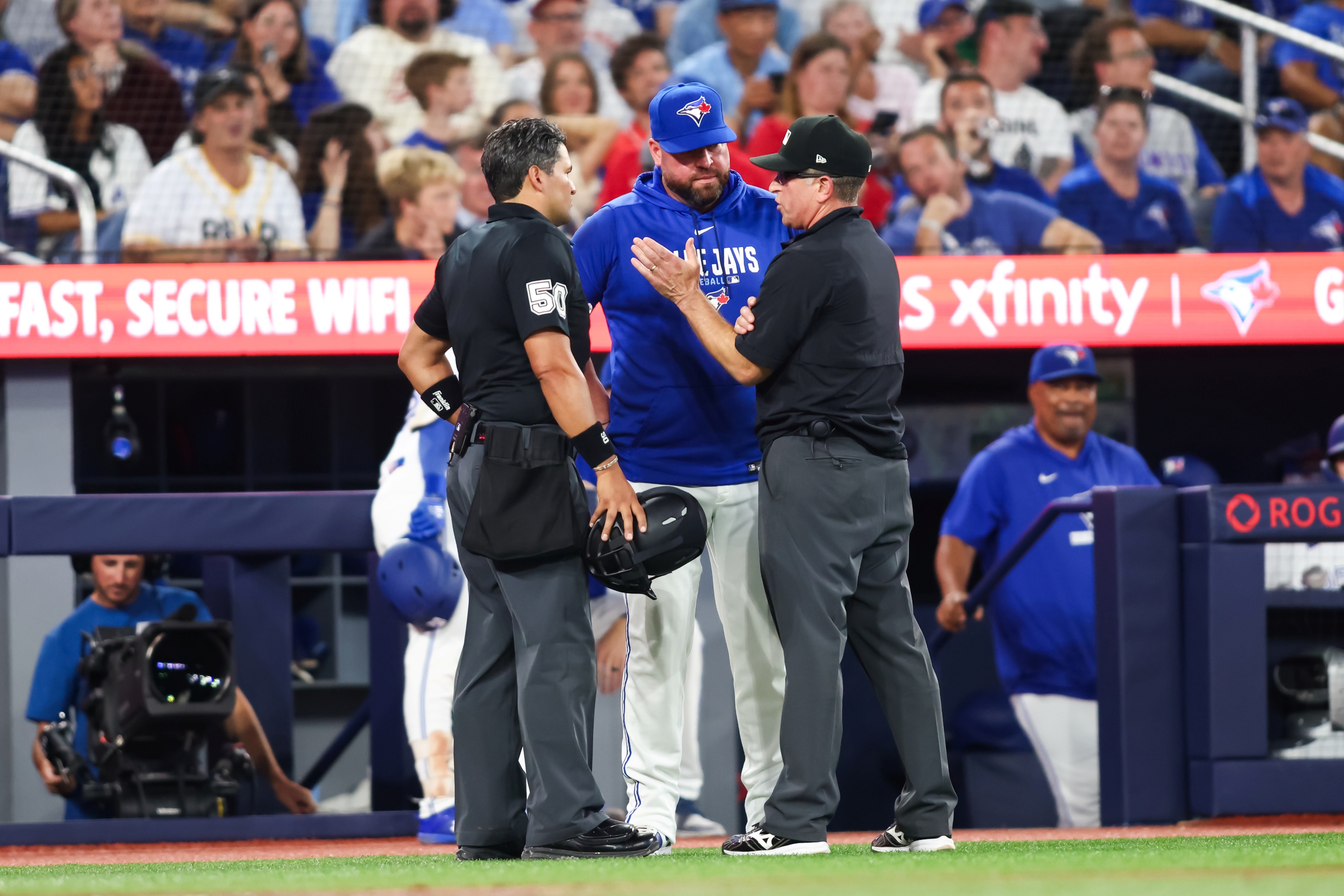
Many individuals have been confused by this, and presumably solely grew to become extra so throughout the 15-minute wait. After the Crimson Sox broadcast got here again from the primary industrial break, they confirmed the umpires conferring after which making an attempt to elucidate their choice to Blue Jays supervisor John Schneider and Crimson Sox supervisor Chad Tracy. This preliminary part of the method took a number of minutes.
Then the umpires needed to flip and attempt to clarify to the stadium. Crew chief Chris Guccione put in his earpiece and took a breath. “OK,” he started, and paused. Uh-oh! “So what we have now right here is,” he continued, earlier than taking one other break. Oh no! “We’ve got a time play, that means when the third play—when the third out was made at first base with the runner not tagging up, the runner that was on third base additionally didn’t tag, however crossed house plate earlier than the third out was made at first base. So, that could be a time play. We’re going to New York to verify—do a guidelines verify.” He ended his announcement to a refrain of boos from the Toronto house crowd.
The wait that adopted Guccione’s clarification stretched on and on. A number of extra minutes later, the method of speaking to the managers started anew. Although Schneider deployed his trademark transfer of rising increasingly red-faced over the course of the dialogue, there was no ejection. Guccione as soon as once more got here out to face the hostile crowd. “All proper, after calling New York, getting all of it straightened out, the run goes to attain,” Guccione mentioned. He paused, to an much more aggressive refrain of boos. “Finish of the inning, two runs for Toronto, one run for Boston.”
What occurred? Nicely, first, the preliminary misunderstanding was probably brought on by the Toronto stadium scorer, who ought to have scored the Sogard play as WW for “wasn’t watching.” We have all been there, buddy. Then the scoreboard evidently confused the Crimson Sox baserunners and a number of other of the Blue Jays into believing that there have been already two outs within the inning, even supposing solely three batters had come up and two of them have been on base on the time of Rafaela’s flyout. Neither runner tagged up, which enabled the Blue Jays to show Rafaela’s would-be sac fly right into a double play by throwing to first and interesting.
Whether or not or not the Blue Jays turned a traditional sac-fly double play was not in query; what was in query was whether or not or not the Crimson Sox would rating a run, because the runner on third had crossed house plate within the time earlier than the Blue Jays had thrown to first and appealed the on the market. Ultimately of a touch upon Rule 5.08 within the official 2026 MLB guidelines, this precise play is referenced for example:
One out, Jones on third, Smith on first, and Brown flies out to proper discipline. Two outs. Jones tags up and scores after the catch. Smith tried to return to first however the correct fielder’s throw beat him to the bottom. Three outs. However Jones scored earlier than the throw to catch Smith reached first base, therefore Jones’s run counts. It was not a drive play.
Rule followers, Cubs followers, and Javier Baez aficionados will notice that within the brain-breaking play Baez made in opposition to the Pittsburgh Pirates in 2021, the outcome was much more ludicrous as a result of the run wouldn’t have counted had Baez not safely made it to first base, as it might have been an inning-ending drive play. As a result of getting thrown out for failing to tag does not qualify as a drive play, that very same rule doesn’t apply right here.
After all, the scenario with the Crimson Sox is extra difficult as a result of the function of “Jones” on this scenario didn’t truly tag up earlier than he scored. Sadly, although the Blue Jays did attraction the third out of the runner failing to tag at first, they didn’t do the identical with the runner failing to tag on third. 5.09(c)(4) on attraction performs states that “attraction performs could require an umpire to acknowledge an obvious ‘fourth out.'” That’s, the Blue Jays may have appealed the run however didn’t, presumably as a result of they already reached three outs, and likewise everybody was confused as quickly as folks began strolling off the sector. What classifies as leaving the sector of play? Nicely, that is “when the pitcher and all infielders have left honest territory on their strategy to the bench or Clubhouse.”
Thus, the scenario as outlined in Rule 5.08 successfully performs out as written. The umpires—and their session with New York—have been right, and in some way, regardless of making a horrible baserunning mistake, the Crimson Sox managed to successfully steal house and are available out of the debacle with one run. To make the scenario much more lovely, the Crimson Sox would go on to lose the sport 2-1, thus rendering the play and the 15-minute evaluation and the fashion and confusion completely, fully irrelevant. Baseball!
