

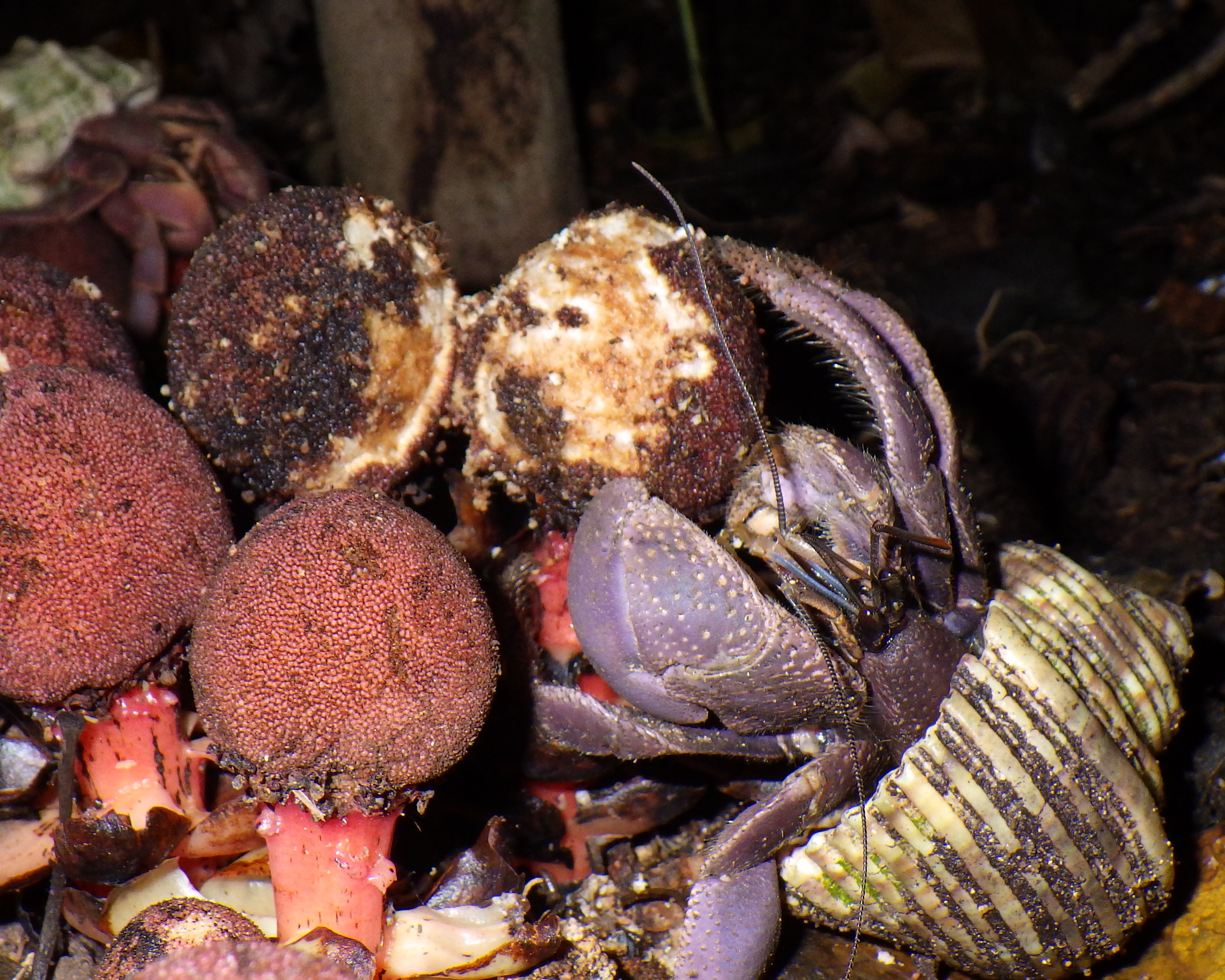
In Okinawa’s coastal forests, brown puffballs protrude from roots of timber like undesirable warts. Though they could seem like mushrooms, the balls are vegetation. To be extra particular, they’re fruits. To be much more particular, they’re clusters of as much as 1,000,000 fruits that every encase a tiny seed, fruits made bigger and extra dazzling by their proximity to one another, fruits designed like pavé diamonds.
However Balanophora fungosa, also referred to as fungus root, just isn’t unusual as a result of it seems to be like a mushroom, and even as a result of it has an unreasonable variety of fruits. It’s unusual as a result of it has no chlorophyll with which to photosynthesize, and it has no roots with which to drink water. As a substitute, the fungus root survives by parasitism, entrenching itself on the roots of timber. In different phrases, it is a freaky little plant. Petra Svetlikova, a plant researcher on the Okinawa Institute of Science and Expertise, stated as a lot in a assertion: “It’s a captivating instance of how one thing so unusual can evolve from an ancestor that regarded like a standard plant with leaves and a standard root system.”
For a very long time, scientists couldn’t work out how the fungus root made extra fungus roots—that’s, the way it reproduced. The disco ball of 1 million tiny dry fruits clearly wanted to be unfold. However how, or by whom? Kenji Suetsugu, a plant biologist at Kobe College, has lastly figured it out. In a brand new paper in Ecology, he reveals the identities of the seed dispersers, that are even stranger than the fungus root itself. It appears the plant has hitched its wagon to cockroaches and hermit crabs, the latter of which have by no means beforehand been noticed to disperse the seeds of a plant.
Suetsugu is not any stranger to unusual dispersers. He is beforehand revealed on vegetation whose seeds are dispersed by Amami rabbits, ants and camel crickets, and roaches and crickets. He distrusted prior theories of how B. fungosa managed to unfold its seed. “Many individuals assumed that they merely fall by gravity and are carried away by the wind, however the humid and windless forest ground makes this appear moderately implausible,” he stated in a assertion. He knew different Balanophora species with firmly connected fruits have been dispersed by cockroaches and crickets, bugs able to biting off the fruits. He knew Balanophora species with simply indifferent fruits have been dispersed by ants.
The fruits of B. fungosa have been straightforward to pluck, so ants appeared the primary suspect. However when Suetsugu lined the bulbous fruits with a mesh that allowed ants however not bigger animals, the plant’s fruits have been completely untouched. Suetsugu switched ways, organising a time-lapse digital camera to see who would come by for a uninteresting, dry kind of fruit salad. To his shock, the fungus root’s most frequent guests have been Australian cockroaches, who would typically flock to a single fruit. However most voracious guests have been Indonesian hermit crabs. The crabs plucked the fruits simply with their pincers and will end a whole puffball in a single night time.
However consuming a fruit doesn’t assure you participate in its seed dispersal. Suetsugu knew what he needed to do subsequent. He collected the droppings from the roaches and crabs that consumed the fungus root and examined their contents. He discovered a handful of intact seeds in every hermit crab poop, in addition to a number of intact seeds within the roach droppings. (I’ll chorus from posting these images, however relaxation assured that they’re there, and they’re intact.) These two unorthodox dispersers have been serving to to protect this plant by defecating at nice distances from their fruity meals. This digestive model of seed dispersal, referred to as endozoochory, is most frequently related to vertebrates. Birds and monkeys, for instance, have huge and roomy guts that may accommodate seeds with out splintering them.
Suetsugu’s paper affords the primary direct statement of a land hermit crab dispersing seeds. However it provides to mounting proof that many invertebrates disperse seeds of their feces, together with earthworms, beetles, crickets, crabs, and slugs. Stories of those dispersers have been lengthy relegated to the realm of anecdote. However Suetsugu and colleagues not too long ago revealed a paper extolling the stunning abundance and excretory powers of invertebrate who disperse this fashion. And Suetsugu suspects that non-photosynthetic vegetation just like the fungus root, which have small and sturdy seeds and reside in windless areas, may notably profit from such animals. In different phrases, the stranger the plant, the stranger the disperser. Plant copy is not simply bees nosediving into the pollen-powdered stomachs of flowers; it is also oily little brown roaches scurrying over a brown progress and hermit crabs consuming 1000’s and 1000’s of seeds after which going for a stroll earlier than shitting them out.
Correction, 8/18 4:00 p.m.: An earlier model of this piece incorrectly referred to seed dispersal as pollination. Defector regrets the errors.
